Founder operations · Our own operation
From idea to shipped, and deciding what not to build
GrowthBridge Transformation
We built a system called Helm to run our own work the way we'd build it for a client. This is the honest story of what it does for us, including the part we didn't expect to matter most.
Why we built it
A two-person practice has the same problem as every small team: more good ideas than hands. They pile up in notes, in chat threads, in one person's head. The urgent crowds out the important. And the most expensive mistake a small team makes isn't doing a thing slowly; it's building the wrong thing well.
We wanted one place where an idea becomes a decision, and a decision becomes shipped work, without anyone having to hold the whole map in their head to keep it moving.
From an idea to something shipped
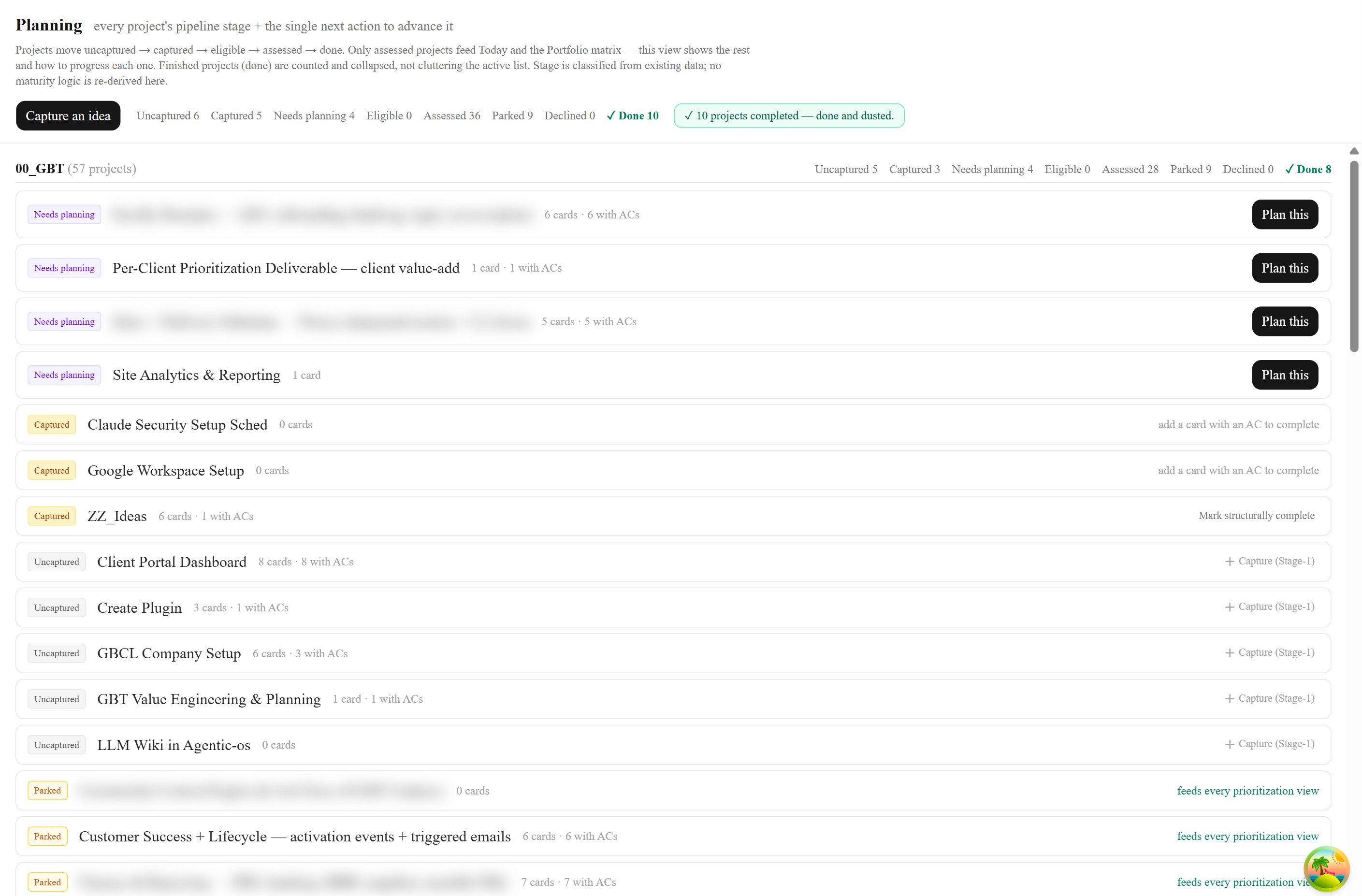
Every idea now enters the same front door. Messy is fine. The system helps us size it, say why it matters and for whom, and, for real projects, draft a plan with an actual definition of done. Then the board does the ranking: what's most valuable, what finishing would unblock, what's closest to done. Open it in the morning and the work that's ready is already in order. It re-checks itself every day: what shipped, what just got unblocked, what's starting to go stale.
The film above walks that whole loop, so we won't re-explain the buttons here. What changed for us is simpler to say: the distance between “good idea” and “shipped” stopped depending on whether the right person happened to remember it on the right day.
The part we didn't expect: deciding what not to do
We thought the value would be in moving work faster. The bigger value turned out to be in not moving some work at all.
When every idea has to come through the same door and say what it's worth, the weak ones show themselves. An idea is allowed to stay an idea. A project is allowed to be parked. Some get a clear, unsentimental no. Making “what not to build” an explicit step, every time and not just when we remember to ask, is the thing we'd have skipped if the system didn't put it in front of us.
Saying no to someone else's idea is easy. Saying no to your own good idea is the hard one, and it's the one that actually protects a small team's time.
What it doesn't do
Helm doesn't decide for us. Every call is still a human one: what's worth it, whether a plan really gets the result, what to kill. The system proposes; we choose. A few surfaces we've designed aren't built yet, and we don't show them as if they were.
It re-checks the board; it doesn't run the business. By our own maturity ladder this is a Level 2 system: a pilot that works, that we still watch. That's the honest read, and we'll update it when it changes.
Why we're showing you ours
Most of our category sells a system they don't run themselves. We run this one every day, on our own work, before we'd ever sell you one. If you're a small team drowning in your own good ideas, the discipline that helped us most wasn't doing more. It was deciding, out loud and on a cadence, what not to do.
Get in touch
Want this for your own team?
A way to take work from idea to shipped, and the discipline to decide what not to build. We build it with you, and you own it after.